
no guessing about expectations
Most dojos ask you to trust that the standard is real. We'd rather you check. Here is the shape of the whole thing: what is required, where it gets hard, and what you must be able to do before anyone awards you anything.
We run two separate curricula. They share a spirit and a lineage, but they are not the same syllabus, and we do not pretend otherwise.
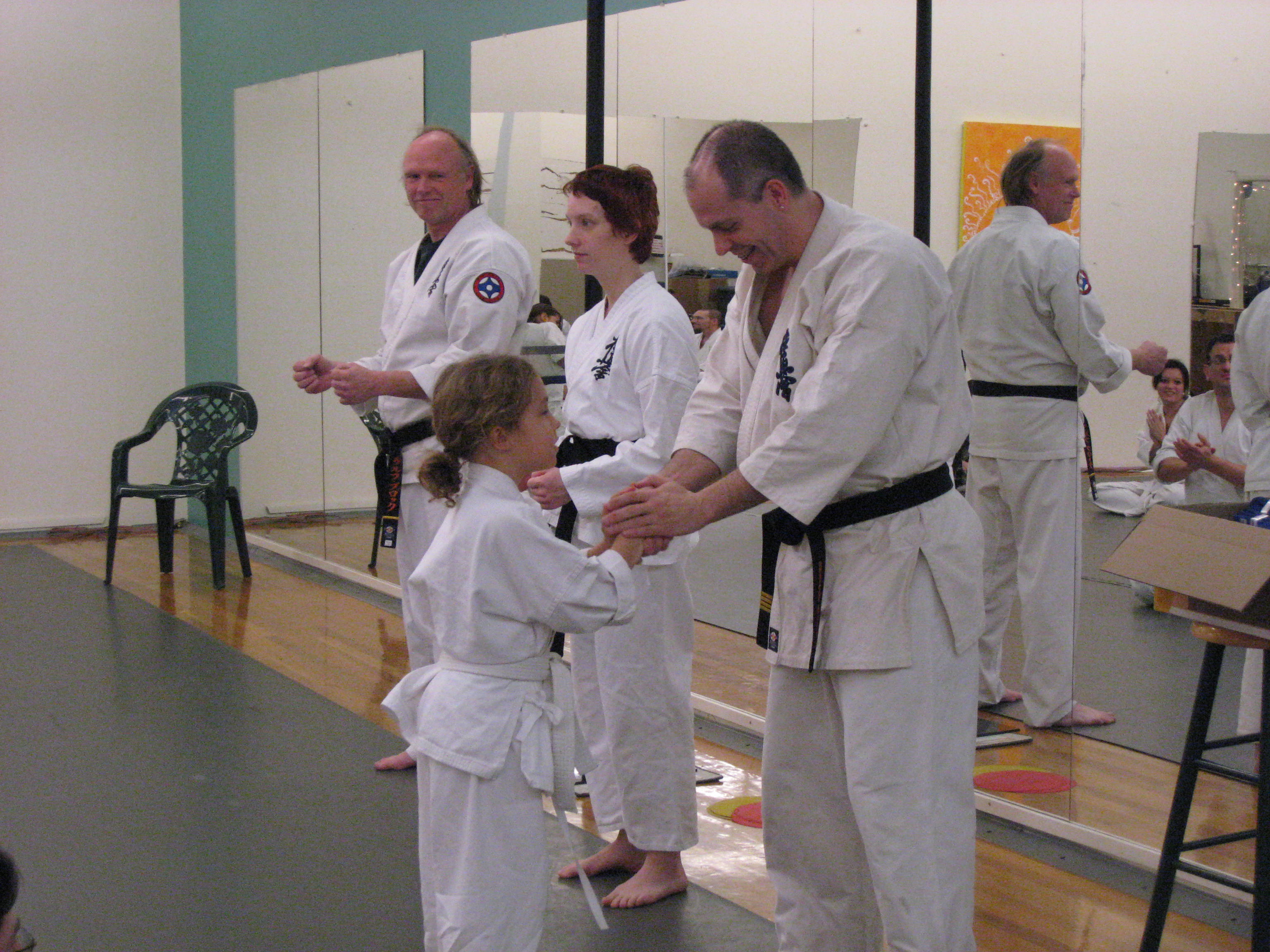
why we publish our expectations
rank is never given. it is earned.

progress beyond technique
In the modern era the meaning of a belt has been diluted - traded for medals, promotions, and the short-term glory of sport karate. A coloured belt now means whatever the school that issued it wanted it to mean.
your belt is earned
Every technique, standard, and requirement, at every rank from white to black belt. If you want to know whether we are serious, don’t take our word for it; read it, then come watch us hold someone to it.
train for more than you
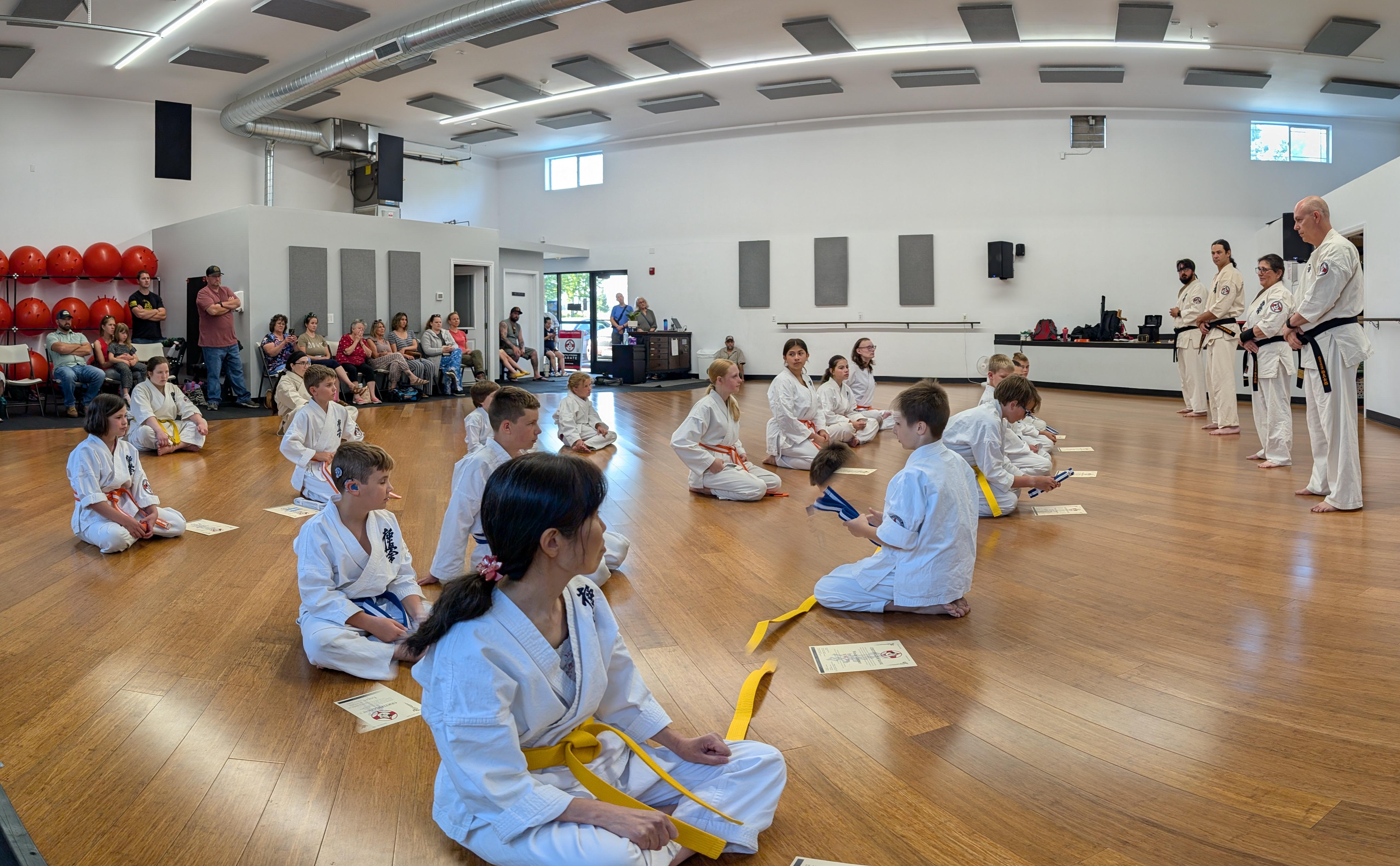
Nobody here tests on a schedule or is promoted to keep them happy or paying. Progress takes as long as it takes. Your instructors decide when you are ready based on your development. Sometimes it's fast. It is usually slow.
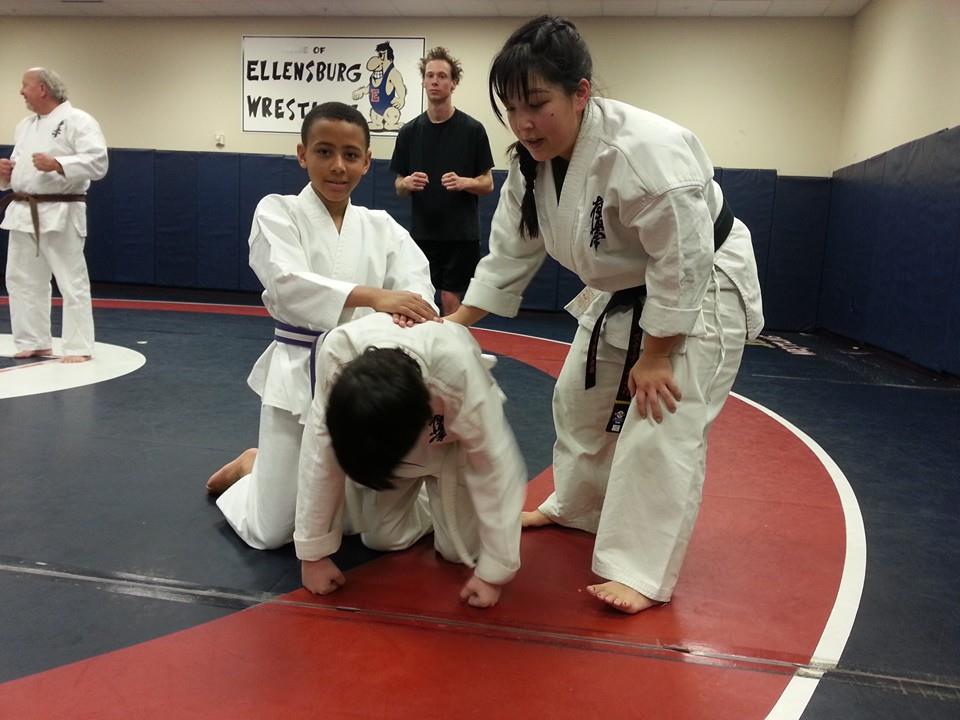
Which is why, when someone here passes, the belt actually means something.
the adult curriculum · ages 14+
eleven ranks to black belt.
Each rank has its own syllabus: stances, strikes, blocks, kicks, kata, weapons, self-defense, throws, grappling, conditioning, terminology, and fighting. Below is the objective of each, and the standard attached to it. The numbers are real and they are minimums. Meeting them does not earn you the belt; failing to meet them means you do not test.
The colors themselves carry meaning - an elemental progression from earth to spirit.
adult rank

The Rank
Solid color

The next step
Bar across, in the next rank’s color

white
mukyu
learn to stand
15 classes min
90 days min
~30 training hours
Orientation. Three stances, two blocks, a punch, a front kick. The dojo, the uniform, how to bow, how to fall safely. Nothing is expected of you except that you show up.

orange
jukyu
earth
balance and coordination
4 bare fist fights
20 pushups, situps, squats
3 kata
Basic punching, striking, blocking, kicking, used as much for balance as for fighting. Three Taikyoku kata. Wrist releases and chokes. Your first four bare-fist fights.

orange + stripe
kukyu
stand and move with confidence
5 fights
25 pushups, situps, squats
75 days in rank
Elbows, knife-hand, crescent kicks. Kiba dachi. First breakfalls and forward rolls. Nunchaku. The 11 Mottos of Sosai Oyama.

blue
hachikyu
water
absorb before you advance
6 fights
30 pushups, situps, squats
90 days in rank
Attempting to advance too fast at this point will be unproductive. First real throws: de ashi barai, o goshi. The 7 Virtues of Bushido.

blue + stripe
shichikyu
Fitness and stamina climbing
7 fights
35 pushups, situps, squats
150 days in rank
Ibuki breathing. Hammer fist, knife hand. Chudan mawashi geri. The 5 Principles of Good Health. Correct kiai in every technique and in kumite.


yellow + stripe
gokyu
sharp and accurate
9 fights
45 pushups, situps, squats
1st board break
The Dojo Kun, learned in English and reflected on. Bo. Jodan mawashi geri. Tameshiwari begins; your first board break.
green
Yonkyu
air
no longer whether. now how well.
10 fights
50 pushups, situps, squats
240 days in rank
The standard moves here, and it moves without warning. It is no longer a question of whether a technique can be performed, but how well it is executed. Students who struggle with any basic technique will not advance. The Dojo Kun, now in Japanese.
green + stripe
sankyu
a fighting style emerges
11 fights
55 pushups, situps, squats
4+ board breaks
Sanchin. Tsuki no Kata. The ground game opens: takedowns, escapes, mount, guard, armbars. The spirit of Osu: to push, to endure, to persevere.

brown
nikyu
Maturity
you must be able to teach
12 fights
60 pushups, situps, squats
300 days in rank
Before you can wear a brown belt, you must be able to instruct a full training session. Jumping kicks. Knife defense. Jiu-jitsu chokes and locks. Strength, speed, and power.

brown + stripe
ikkyu
maturity, integrity, leadership
13 fights
65 pushups, situps, squats
390 days in rank
Gun defense. Free-form jiu-jitsu against different-sized opponents. Tensho, Sanchin-Tensho, Entensho. Tameshiwari speed break. Respect the trust that lower kyus bestow.
the junior curriculum · ages 6+
the same path. built for a child.
The junior syllabus is not a watered-down adult one, and it is not a different art. It is the same curriculum, scaled; fewer fights, one weapon instead of six, throws introduced later, and objectives written for a developing person rather than a finished one.
What a parent should know first: children fight here. One supervised bout to start with progression over time. Controlled and watched closely - but real. We would rather tell you that now than have you discover it after the fact.
junior rank

The Rank
White stripe down the length

The next step
Plus a bar across, in the next rank’s color
white
mukyu
begin with the right spirit
— no kata yet
— no weapons yet
The dojo, the uniform, how to bow, how to line up. Basic stances and moving with balance. No kata yet, no weapons yet. Falling safely.

orange
jukyu
earth
foundation for balance and coordination
1 padded fight
15 pushups, situps, squats
60 days min
Basic punches, blocks, knee and groin kick. An I-pattern with proper foot placement. Nunchaku basics. Wrist escapes. One fight.

orange + stripe
kukyu
observable competency
2 fights
20 pushups, situps, squats
60 days in rank
Kiba dachi. Elbow strikes. Taikyoku Ichi. Standing forward roll and breakfalls. Two fights. Quiz: what does Kyokushin mean, and who was Mas Oyama.

blue
hachikyu
water
confidence in the basics
3 fights
25 pushups, situps, squats
60 days in rank
Back-fist, knife hand, low roundhouse kick. Nunchaku Ichi. Chokes and a head-kick block. Three fights. The 7 Virtues of Bushido: justice, loyalty, compassion, honesty.

blue + stripe
shichikyu
develop a growth mindset
4 fights
30 pushups, situps, squats
90 days in rank
Ibuki breathing. Hammer fist. Sanchin dachi. Defense against a straight punch. Four fights. The 5 Principles of Good Health.

yellow
rokukyu
fire
begin to serve. begin to lead.
5 fights
35 pushups, situps, squats
90 days in rank
Zanshin, Mushin, Fudoshin: introduced here, as they are for adults. Knife-hand strikes. Front hair grab. Five fights.

yellow + stripe
gokyu
decision-making under fire
6 fights
40 pushups, situps, squats
90 days min
Pinan Ichi. Palm-heel strikes. Jodan mawashi geri. Double collar grab. Six fights. Ukemi now from any direction, with speed.
green
Yonkyu
air
a level mind under aggression
7 fights
45 pushups, situps, squats
✓ throws
120 days
The turn. All basic techniques must be mastered by this stage. Handle conflict with calm decision-making. Serve others unselfishly. Throws begin here: kuzushi, the eight points of balance. Seven fights.
green + stripe
sankyu
an individual style emerges
8 fights
50 pushups, situps, squats
120 days min
Improvisation under changing conditions. Elbow strikes, hook kick. Ashi barai. Eight fights. The first line of the Dojo Oath, in Japanese.

brown
nikyu
maturity
inspire others to serve
9 fights
55 pushups, situps, squats
180 days in rank
Build community capacity for kindness. Technique without conscious thought. Uki waza. Nine fights. Habits for lifelong learning.

brown + stripe
ikkyu
explain it to someone else
10 fights
60 pushups, situps, squats
✓ teach technique
180 days in rank
Jumping kicks. O goshi, ippon seoi nage. Pinan Go. Ten fights. Can explain the Bushido Code, the 5 Principles, and the 3 States of Mind, and how to execute a technique, with understanding.
Time alone does not earn promotion. This is written on every junior rank sheet. Instructors decide when a child is ready based on training, journal, and performance. Not on how many months have passed, and not on how much anyone wants it.
What you're seeing, and what you're not
Everything above is the standard: the objectives, the minimums, the numbers you will be held to. We publish it because a standard nobody can check isn't a standard, it's a claim.
What we don't publish on our website is the syllabus itself: the several hundred named techniques, the kata sequences, the specific applications, the corrections. Not because it's secret - you can find most of it in any Kyokushin text - but because a list of techniques teaches nobody anything. Knowing that brown belt requires twelve fights tells you what kind of school this is. Knowing the name of a block does not make you able to throw one.
Enrolled students receive the complete curriculum on their first week: every rank, every technique, with video, and the journal that tracks it. It is part of the training, not an extra.
why the order is the order
Belts are not a scoreboard
The colors are not arbitrary and they are not a ranking per se; they are milestones based on achievement. They follow an elemental progression, each with a focus the student is being asked to develop. This is the oldest layer of the curriculum and the one most schools have quietly dropped.
before
white
purity · potential
the task
Show up. Keep showing up.
No grade at all: mukyu means exactly that. The white belt's heart is said to be full of hope, and from that hope comes the first willingness to train. The purity is gone the moment you sweat on it.
first
orange
earth · stability
the task
Build the base.
Power and progress are built on a solid foundation. Stances, and the ability to stand in them. The internal battle here is simply against the part of you that does not want to come to class.
second
blue
water · fluidity
the task
Adapt, and stay level
Physical and mental fluidity - the capacity to react rather than to brace. The blue belt is learning heijoshin: the unchanging state of mind. Receive a blow like water. Be fluid in mind and body.
third
yellow
fire · assertion
the task
Find the hara. Commit.
The point of commitment. Power is generated from the hips and waist - the hara - and the student begins to feel it. Perception, awareness, and willpower now matter as much as technique.
fourth
green
air · compassion
the task
Understand what power is for.
The first of the senior colors. Student becomes aware of why benevolence and compassion matter - and realizes that power without wisdom is destructive. Sensitivity, timing, and first glimpses of zanshin.
fifth
brown
maturity · responsibility
the task
Lead, and keep going.
Responsibility in and out of the dojo. Creativity in technique. A disciplined life in words, thoughts, and deeds. The trap: the brown belt too often becomes complacent for being top of junior grades. Do not stop here.
“Strength without justice is violence. Justice without strength is impotence.”
— sosai mas oyama
Read the progression again and notice what it does not do. While we focus on fighting and self defense, we never glorify violence. The curriculum moves from standing up, to moving well, to committing, to compassion, to responsibility, to humility. The techniques get harder. The person is asked to get kinder. That is not a contradiction. It is the entire point.
black belt
shodan is not the end.
it is the entrance fee.
shodan
First degree · 1,000 days since 10th kyu
This grade is the beginning of learning in Kyokushin Karate. Every prior rank was a prerequisite for this moment. It is the culmination of many days of hard training, and it is a beginning.
6+ hours no rest
300 jumping jacks
50 x 3 x 5 rounds pushups, situps, squats
30+ rounds kihon, ido geiko, and renraku
2x every kata performed, applied, with history
6 weapon systems nunchaku, escrima, bo, tonfa, sai, iaido
complete self defense core defense, goshin jutsu, jiu jutsu
16+ bare-fist fights
And a requirement that is not physical: leadership and service to others is an expectation.
Nidan
second degree · 2+ years since shodan
No one is promoted to Nidan for training hard. Training hard is assumed. The physical standard escalates, as appropriate for body age. What truly escalates is responsibility.
refined technique, power, control, timing, spacing, and focus
remain coachable, accept feedback, and continue learning without ego
develop a student through a full grading cycle
assessed on their improvement, not just yours
teach a designated kata to someone who has never seen it
kumite against larger, smaller, grappler, striker
a documented record of service to the dojo
20+ bare-fist fights
A student who arrives at Nidan asking when they will be graded has misunderstood the rank, and will not be promoted.
The adult curriculum · running through all of it
focal points for learning.
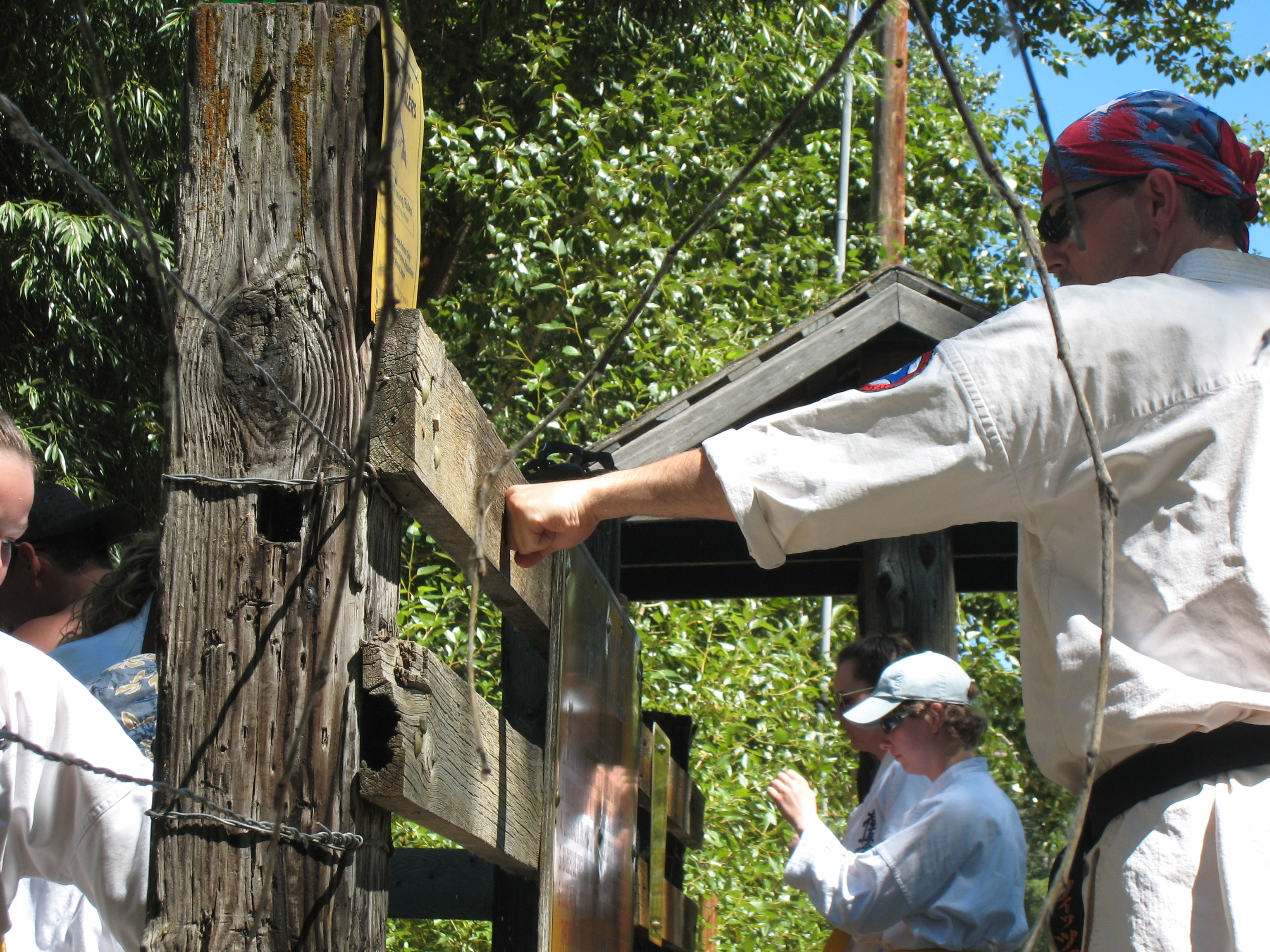
Alongside the kihon and kumite of each grade, four disciplines develop continuously from white belt to black. They are not electives. The junior curriculum runs three of these - kata, self-defense, and throws - with weapons limited to the nunchaku throughout.
kata
forms
Taikyoku through Sokugi, Pinan, and the advanced forms. Performed in Ura and Tate. By Shodan: every kata, twice, and blindfolded.
Kobudo
weapons
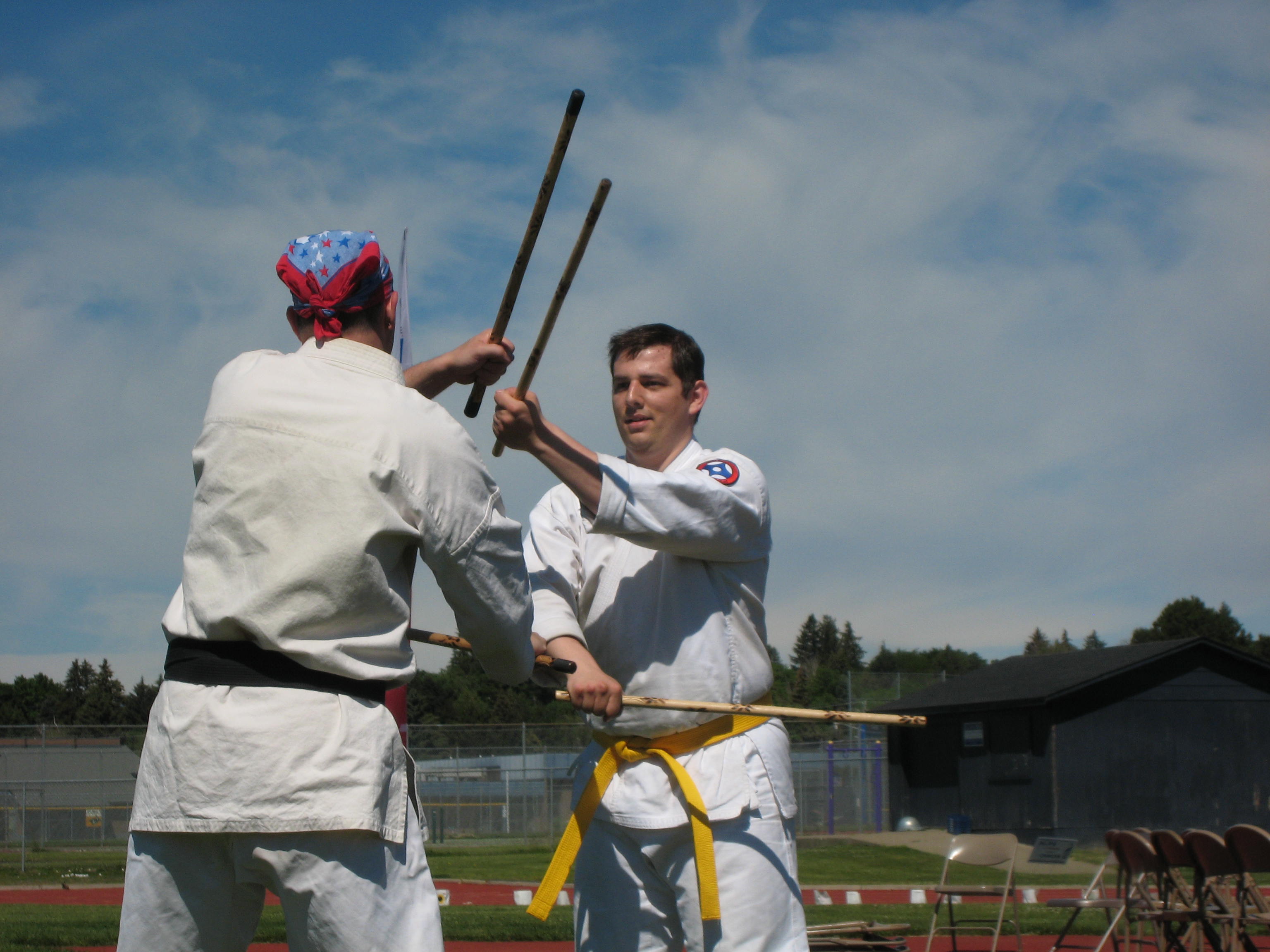
Nunchaku, escrima, bo, tonfa, sai, iaido. Six systems, examined like everything else. Almost nobody still teaches this.
Nage · Ukemi
falls and throws
Learn to fall before you learn to throw. 10+ throws by black belt, plus the ground work and grappling to finish what you started.
goshin jutsu
self defense
Wrist grabs and chokes, then headlocks and bear hugs, then weapons. Trained against real resistance with real contact.
Both curricula · every rank
every student keeps a journal.
Adults and children alike. A binder, the syllabus in sheet protectors, a dry-erase marker to check off what you can do on your own. And every week, at every rank, for as long as you train, three questions.
It is a requirement, not a suggestion. It is also, in our view, the most transferable thing in the entire curriculum. Journaling cultivates self-assessment, accountability, and intentional learning. Most adults have never built that habit. It works on a bad grading and it works on a bad week at work.
asked routinely · every rank

what has gone well
what has not gone well
what you need to do to improve
You've read the standard.
Now come and watch us
hold someone to it.
The numbers on this page are not a brochure. Sit at the back of a grading and watch someone fail to meet them. Your first class is free.


Copyright © 2026 Ultimate Truth LLC